


What’s a Real Service Dog? FAQ’s Answered by a Professional
Mental health awareness is at an all-time high in the US. Because of this, there are more people seeking psychiatric service dogs than ever before. However, the supply from organizations hasn't been able to keep up with the demand. This has led to more and more people training service dogs for themselves. To do this successfully, education on the laws and requirements is a must. Here are the most common questions I see asked about service dogs and their training! (For the sake of clarity, this applies to the US only. International laws will be different, and individual states may have different laws that are less restrictive.)
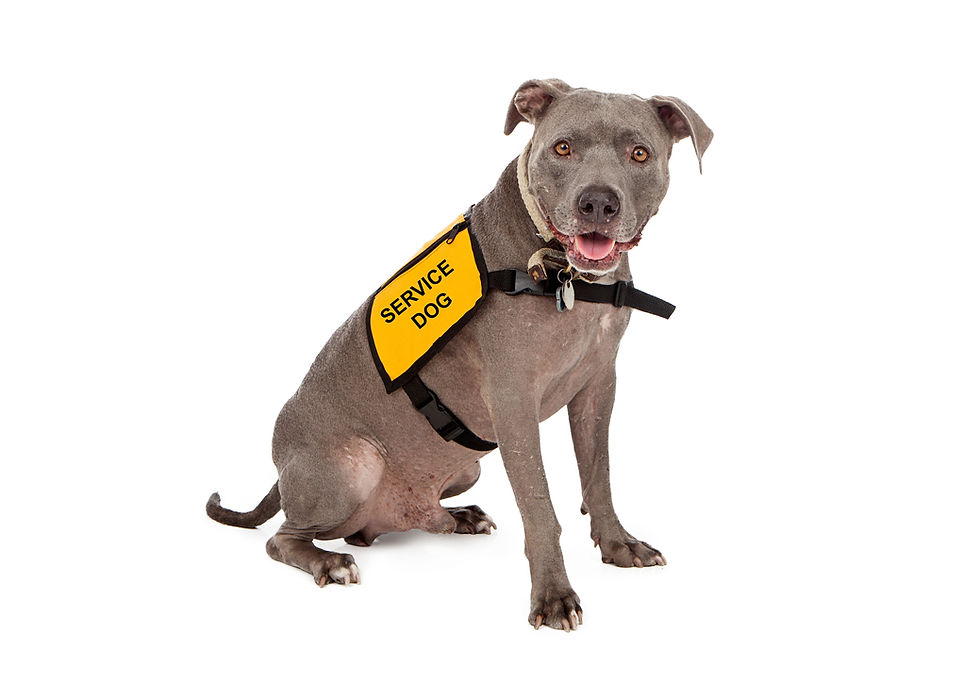
What is a service dog?
According to the Americans with Disabilities Act (ADA) "Service animals are defined as dogs that are individually trained to do work or perform tasks for people with disabilities... The work or task a dog has been trained to provide must be directly related to the person's disability."
In short, it is a dog* that knows how to do a specific thing to make living with a disability easier and/or safer. This is commonly referred to as a task, or that the dog is “working”. This can be for any disability. The dog has to do something specific, meaning it has to be more than just the presence of the dog that helps the person. Service dogs are not emotional support animals, and they are not therapy/comfort dogs.
*The ADA does make an exception for miniature horses.
How many tasks does a service dog need to do?
A common misconception I've heard is that a service dog must know at least three tasks to be legally considered a service dog. This is not true. A service dog only needs to know ONE thing that helps with a handler's disability to be a service dog. However, training a service dog takes a lot of time and resources. Because of this, most people would not choose to train a dog just for one task. Disabilities are so varied, though, that it's impossible to say what is and isn't worth the effort!
How do you make a dog a real service dog?
In the US, there is no license, certificate, registry, or test required to make a dog a service animal. As long as they meet the definition above, they are a service dog. Some areas do have an optional registry (optional is a very important word there.) So, to make a dog an "official" service dog, their handler has to be disabled, and they have to know at least one task. That's it!
Can someone ask for proof that your dog is a service dog?
Business employees and owners are only allowed to ask two questions:
-Is this dog a service animal required because of a disability?
-What work or task has the dog been trained to perform?
If a business owner asks anything other than this, there is no obligation for the handler to answer. I suggest that anyone who gets asked more questions asserts their right to privacy to keep all handlers safe from invasive questioning.
Do service dogs really go everywhere with their handlers?
There are actually a few public places where a service dog is not allowed public access. If a dog will "fundamentally alter" the function of an area, or the dog will compromise health protocols, then service dogs aren't allowed. Some examples are allergy-free dorms, inside a public swimming pool, and a sterile wing of a hospital like a burn unit. Religious establishments are also not covered under the ADA. Because of that, service dogs might not be allowed in places of worship.
An individual handler might also choose not to bring their dog everywhere with them. Some people only need their dog for certain places or situations. Disabilities come in a limitless number of variations, so it makes sense that the way service dogs are utilized has just as many options!
Can a service dog handler be kicked out?
Service dog handlers can be asked to remove their dog from an establishment if their dog is not under control. This can look like the dog barking, causing property damage, invading other people's space (eg digging in someone's bags, jumping on someone), or the dog biting someone. Dogs will also be denied access if they pee or poop inside. Essentially, if the dog is causing a significant intrusion, or is dangerous, they can be kicked out. However, the handler themselves cannot be asked to leave. The laws are there to protect the handler's rights, not the dog's rights. Even if a business owner asks the dog to leave, they cannot ask the handler to leave for having the dog, regardless of how the dog is behaving.
Are dogs training to be service dogs (SDiTs) covered under the same laws as fully trained service dogs?
On a federal level, only fully trained service dogs are allowed public access. However, different states do have different laws about dogs in training. For example, Massachusetts gives SDiTs the same rights as service dogs, regardless of who is training them. Other states may only allow SDiTs public access if they're being trained with a professional trainer, or with an organization.
How do you know if a dog would make a good service dog?
I mentioned that the laws are not very specific in the US already. However, just because a dog can legally be considered a service dog, that doesn't mean they should be. A good candidate...
-Is physically and mentally healthy
-Is confident
-Is food-motivated
-Can physically perform the tasks needed
-Enjoys training and working
The handler's abilities and skills are equally as important to have success with a service dog. For more information, you can take this quiz I made: https://uquiz.com/1pr4XS
How can you tell if a dog is a fake service dog?
Service dogs can be any breed, size, or age. They can be mixed breed or purebred. Service dogs also do not have to wear anything that identifies them as a service dog, such as a vest, bandana, collar, or wrap on their leash. In short, a service dog can't really be identified by looks alone.
In addition, the US laws are very loose on how a service dog should behave. As long as they're not obtrusive and they know how to do a task, they're considered a "fully trained" service dog. This technically means a service dog, as legally defined, could...
-Pull on the leash
-Sniff people's behinds
-Eat stuff off the floor
-Be very anxious in public
-Not be dog friendly
-Not know how to sit
-Not be able to settle
-And more!
Really, the only way to know if a dog is a service dog is to ask their human the two questions listed above.
As service dogs have become more common, fake-spotting of service dogs has also run rampant. However, the problem is not that people are being dishonest. The problem is that there isn't enough education about the laws around service dogs, or what's appropriate service dog etiquette. As you’ve probably noticed, the laws in the US also don’t help with the issue. I’ve learned that it’s not worth the effort to try and decide which dogs are “legit” and which aren’t. Instead, treat people with kindness, and encourage them to learn more about service dogs. This is the best way to improve access for disabled people, and create a safer world for our four-legged heroes!
Louca Hill, PCT-A, FFCP

Louca Hill is a professional service dog trainer and a service dog handler himself. For more information, go to https://www.infinitycaninedogtraining.com
References:


Comments